
Professor Giancarlo Fiorenza named a Distinguished Guest Speaker for MSU's Hollander Lecture Series
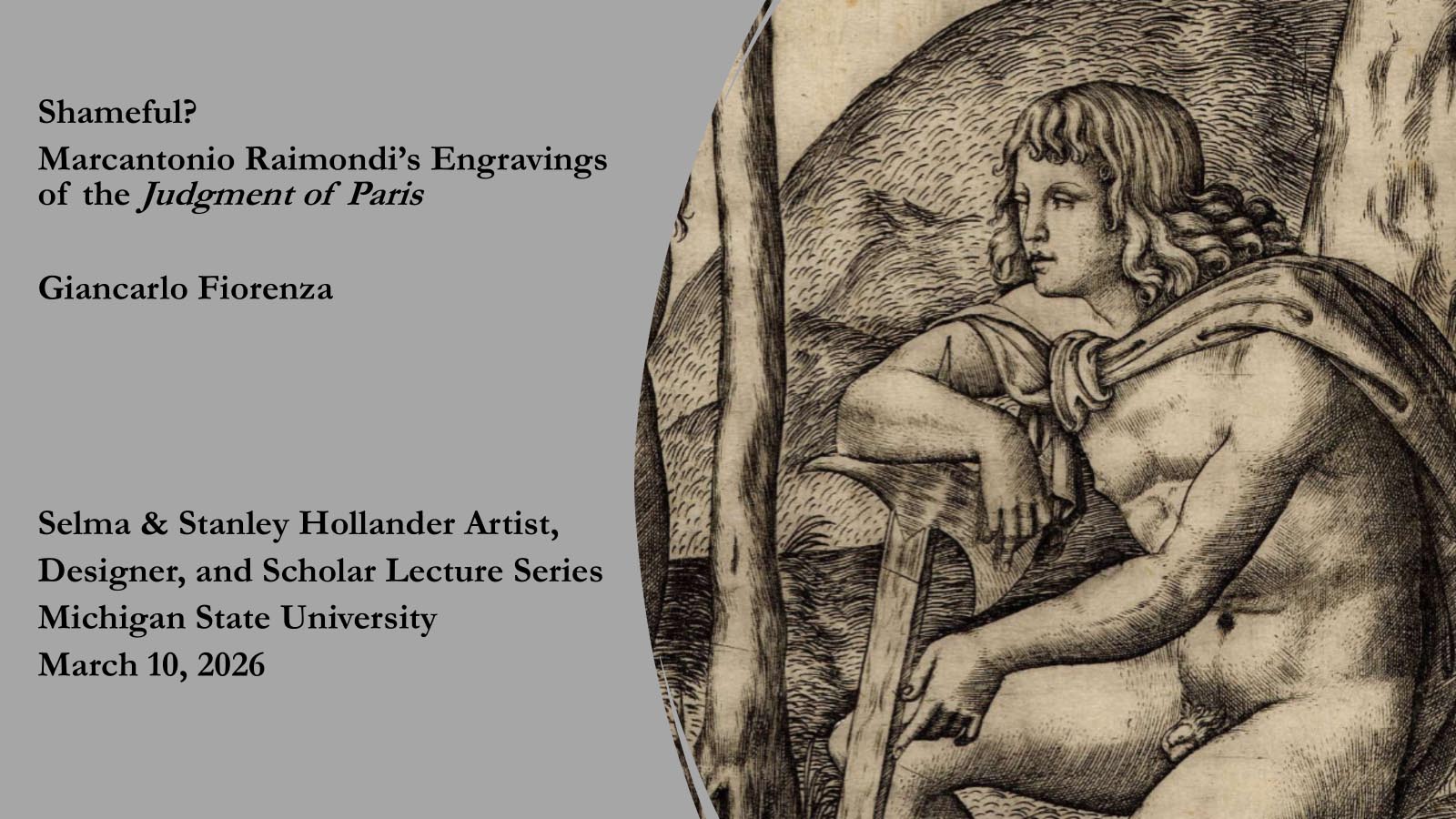
Professor Giancarlo Fiorenza, has been invited to present a lecture on his current research at Michigan State University as part of the Hollander Lecture Series. The title of his lecture is "Shameful? Marcantonio Raimondi’s Engravings of the Judgment of Paris."
Through its annual Selma & Stanley Hollander Artist, Designer, and Scholar Lecture Series, the Department of Art, Art History, and Design at Michigan State University hosts several internationally recognized leaders in the fields of art and design, who each offer inspiring talks that explore how visual representation in all its complex forms exists as a mode of inquiry.
The 2025-2026 Selma & Stanley Hollander Artist, Designer, and Scholar Lecture Series will bring several distinguished guests to campus. All the events that are planned as part of this series are free and open to the public.
During their visit, the invited guests, who come from all around the world, will present their scholarly and creative research in a public lecture. In addition to the lectures, a variety of activities, such as workshops, class visits, panel discussions, and exhibitions, also are planned to give students and the public opportunities to further engage with the visiting lecturers. Graduate and advanced undergraduate students also have opportunities to participate in individual studio visits and group critiques with guest lecturers.
Cal Poly's own Art Historian, Giancarlo Fiorenza, has been invited to present a lecture on his current research at Michigan State University on March 10, 2026. The title of his lecture is "Shameful? Marcantonio Raimondi’s Engravings of the Judgment of Paris."
Giancarlo Fiorenza is an art historian of the early modern period and a Professor of Art History in the Department of Art and Design at California Polytechnic University. From his book on Dosso Dossi’s intriguing oeuvre to his recent work on Marcantonio Raimondi, his focus has been on the significance and topicality of mythological and alchemical subjects to the Renaissance minds. He has a Ph.D. from Johns Hopkins University and has worked in both museum and academic fields, holding curatorial positions at the Toledo Museum of Art and the Georgia Museum of Art.